U.S. Consumer Debt Hits $18.19 Trillion in Q1 2026
PR Newswire
ATLANTA, May 28, 2026
Subprime Borrower Activity Fuels Bankcard Growth; Delinquency Rates Improve for Most Loans, but Rise for Student Debt
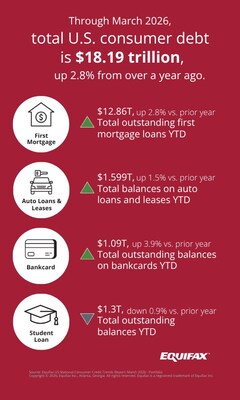
ATLANTA, May 28, 2026 /PRNewswire/ -- Equifax® (NYSE: EFX) has released its Market Pulse First Quarter U.S. Consumer Credit Trends, which includes U.S. national consumer credit data and trends through March 2026 sourced from Equifax proprietary data. Consumer debt balances reached an all-time high of $18.19 trillion in March, heavily influenced by an increase in subprime borrowers opening new bank cards and carrying higher balances. The data showed signs of stabilization in some delinquency rates, a deepening "K-shaped" credit landscape characterized by an increased reliance on subprime bankcards and rising student loan defaults, and strategic lender efforts to improve asset quality through higher write-off rates.
Increased Reliance on Credit Among Subprime Consumers
Outstanding balances in revolving credit, specifically bankcard, are up almost 4% year-over-year, which is outpacing the March 2026 inflation rate of 3.3%. This increase is largely fueled by a surge of subprime borrowers opening new bankcards. Overall, the number of new bankcard accounts grew by 8.1% year-over-year as of January 2026, with subprime originations specifically experiencing an 18.6% increase in new accounts over this 12-month period. Additionally, credit limits among this group increased 37.6% compared to the previous January.
"We are seeing an expansion in the subprime market that underscores the widening gap of the K-shaped economy," said Maria Urtubey, Equifax Advisor. "Lenders originating more bankcard accounts for consumers in subprime while also increasing total credit limits suggests that, for the lower economic tier, credit may have moved beyond a financial tool and may be becoming a necessity for managing the rising costs of living."
Fewer Student Loans Being Originated but Origination Amounts and Delinquency Rates Continues to Grow
While the number of new student loan accounts declined by more than 10% year-over-year as of January 2026, the dollar amount originated still increased by 4.7%, likely reflecting the rising costs of education.
Existing student loan balances continue to decrease due to servicer adjustments for interest waivers and forbearance, as well as borrowers transitioning from the Saving on a Valuable Education (SAVE) Plan to other income-based repayment programs.
Student loan delinquencies continued to trend upward as the 90+ days past due delinquency rate reached 17.01% in March. This increase marks the fourth consecutive month of student loan delinquency increases, although the rate remains more than 9% below the historic peak recorded in May 2025.
"Historically, consumers have prioritized mortgage and auto payments over student loans," said Urtubey. "However, as stricter enforcement measures are restarted, we may begin to see disruption in this 'payment hierarchy', potentially introducing stress into other credit categories."
Improving Delinquencies But Rising Write-Offs Suggest Normalization
Outside of student loans, most consumer credit indicators showed improving 60+ day delinquency rates month-over-month.
- Unsecured personal loans dropped from 3.49% in March 2025 to 3.18% in March 2026.
- Bankcards fell from 3.09% in March 2025 to 2.97% in March 2026.
- And auto loans slightly decreased from 1.51% in March 2025 to 1.49% in March 2026.
This positive trend in delinquency rates was contrasted by rising write-off rates. Both bankcard and auto portfolios saw an increase in write-off rates. Bankcard write-off rates were up 0.9 basis points and auto loans and leases rose up to 27.5 basis points. Typically, delinquencies and write-offs move in tandem, however, the current data demonstrates more of a "lagging indicator," representing accounts that likely became delinquent months ago and have finally reached the point of being uncollectible. Additionally, lenders may be more proactively recognizing losses to rationalize their balance sheets for the 2026 fiscal year.
"For consumers, the fact that delinquency rates are trending positively is an early indicator of resilience," Urtubey said. "For the financial system, the rising write-offs represent a necessary adjustment to bring risk levels back to a sustainable baseline."
Month-Over-Month and Year-Over-Year Results
Total Consumer Debt Balances
Month | Total Consumer Debt ($T) | MoM Change (%) | YoY Change (%) |
January 2026 | $18.21 | 0.1 % | 2.9 % |
February 2026 | $18.19 | -0.1 % | 2.9 % |
March 2026 | $18.19 | 0.0 % | 2.8 % |
First Mortgage Balances
Month | First Mortgage Balances ($B) | MoM Change (%) | YoY Change (%) |
January 2026 | $12,827 | 0.0 % | 3.1 % |
February 2026 | $12,854 | 0.2 % | 3.1 % |
March 2026 | $12,860 | 0.1 % | 2.8 % |
Home Equity Lines of Credit (HELOC) Balances
Month | HELOC Balances ($B) | MoM Change (%) | YoY Change (%) |
January 2026 | $426.2 | 1.1 % | 12.7 % |
February 2026 | $427.8 | 0.4 % | 12.8 |
March 2026 | $431.0 | 0.7 % | 13.0 % |
Auto Loan Balances
Month | Auto Loan Balances ($B) | MoM Change (%) | YoY Change (%) |
January 2026 | $1,594 | 0.3 % | 0.7 % |
February 2026 | $1,594 | 0.0 % | 0.7 % |
March 2026 | $1,599 | 0.4 % | 1.5 % |
Bankcard Balances
Month | Bankcard Balances ($B) | MoM Change % | YoY Change (%) |
January 2026 | $1,122.3 | -0.1 % | 4.0 % |
February 2026 | $1,100.1 | -2.0 % | 4.2 % |
March 2026 | $1,085.2 | -1.4 % | 3.9 % |
Student Loans Balances
Month | Student Loan Debt ($B) | MoM Change % | YoY Change (%) |
January 2026 | $1,316 | -1.0 % | -2.4 % |
February 2026 | $1,305 | -0.8 % | –1.4% |
March 2026 | $1,302 | -0.2 % | -0.9 % |
Equifax has been tracking U.S. National Consumer Credit Trends for more than 20 years. Monthly reports can be found on Equifax.com. These reports track originations, balances and delinquencies on U.S. consumer mortgages, auto loans and leases, student loans, bankcards and private label credit cards, and personal loans. To explore Equifax tools that deliver U.S. National Consumer Credit Trends data and key market metrics click here.
*To view the included graphic, click here.
ABOUT EQUIFAX INC.
At Equifax (NYSE: EFX), we believe knowledge drives progress. As a global data, analytics, and technology company, we play an essential role in the global economy by helping financial institutions, companies, employers, and government agencies make critical decisions with greater confidence. Our unique blend of differentiated data, analytics, and cloud technology drives insights to power decisions to move people forward. Headquartered in Atlanta and supported by nearly 15,000 employees worldwide, Equifax operates or has investments in 24 countries in North America, Central and South America, Europe, and the Asia Pacific region. For more information, visit Equifax.com.
FOR MORE INFORMATION:
Tiffany Smith for Equifax
mediainquiries@equifax.com

 View original content to download multimedia:https://www.prnewswire.com/news-releases/us-consumer-debt-hits-18-19-trillion-in-q1-2026--302783707.html
SOURCE Equifax Inc.
