
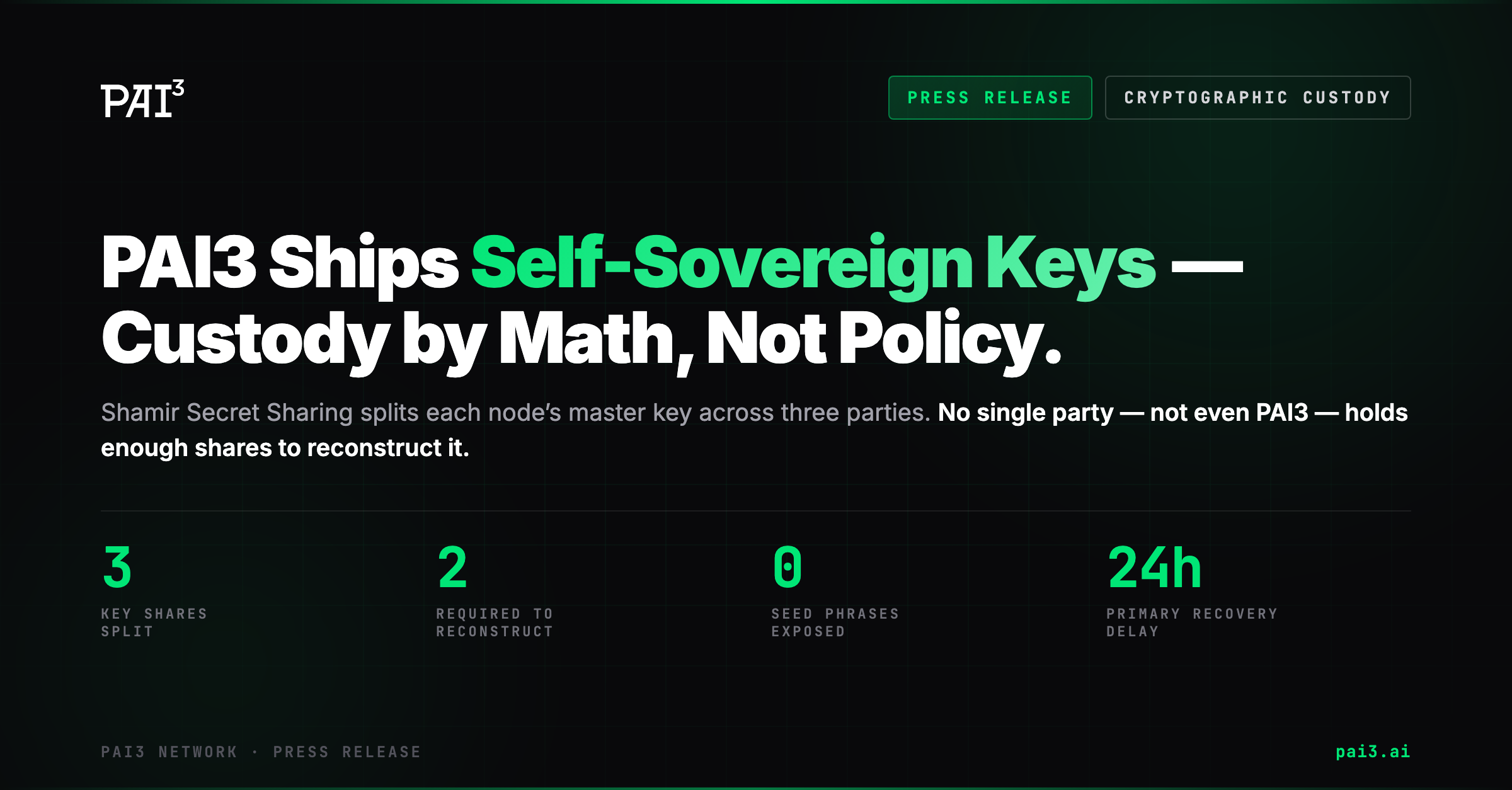
Cheyenne, WY - May 5, 2026 - PAI3 Network today introduced its self-sovereign key management architecture, a cryptographic design intended to make it mathematically impossible for PAI3 - or any single party - to access user data, even under compulsion.
The architecture uses Shamir's Secret Sharing to split each node's master encryption key into three shares. Any two shares are required to reconstruct the key. Share 1 is bound to the user's device. Share 2 is derived from the user's authentication session through Privy. Share 3 is held in encrypted escrow for recovery. No single party - not PAI3, not Privy, not the device manufacturer - holds enough shares to reconstruct the key independently.
"In information security, the weakest link is custody," said Pradeep Goel, CEO of PAI3 Network. "Most platforms promise they won't look at your data. We've built an architecture where, by design, they can't. That isn't a policy - it is mathematics. It's the standard every AI infrastructure provider should be held to."
The key management system derives all subordinate keys - per-cabinet encryption keys, oracle credential keys, HIPAA database keys, JWT signing keys, and blockchain signing keys - from the master key through a hierarchical derivation chain. A single key reconstruction event at node startup secures the entire system.
Recovery without a central authority
PAI3 has designed a dual-path recovery model. The primary path uses a Privy-escrowed recovery ceremony with multi-factor authentication and a 24-hour waiting period. The accelerated path allows users to designate trusted guardian nodes - other PAI3 nodes in the network - who can approve recovery in minutes through a simple "was this you?" prompt.
For users without sufficient trusted contacts, PAI3 will offer a managed guardian service. The guardian holds only one sub-share of the recovery share - mathematically insufficient to reconstruct the master key. Self-custody is preserved while providing a safety net.
The user experience is designed to stay invisible. No seed phrases. No paper recovery kits to print and store. Users can sign in with email, social login, or - as of the latest PAIneer release - a mobile wallet via WalletConnect. The key management operates entirely behind the scenes.
Why the design matters for regulated professionals
For healthcare providers, the key architecture means patient data is encrypted with keys that PAI3 cannot reconstruct. PAI3 is HIPAA-ready by design and does not hold key material that could compel disclosure. For attorneys, the same property protects privileged communications. For accountants, client financial data remains under the operator's mathematical custody, not a vendor's promise.
Each node generates its own keys at startup. PAI3 servers never see plaintext key shares. The platform cannot satisfy a subpoena for data it has no cryptographic ability to produce.
Technical summary
-
Shamir 2-of-3 secret sharing for the node master key
-
Hierarchical key derivation for cabinets, oracles, signing keys
-
Privy-escrowed primary recovery (MFA + 24-hour delay)
-
Guardian-node accelerated recovery (peer approval, minutes)
-
Optional PAI3 managed guardian service (single sub-share, never sufficient alone)
-
AES-256-GCM cabinet encryption derived from the master key
-
Sign-in via email, Metamask, or WalletConnect mobile wallet
-
No seed phrases or paper recovery kits exposed to the user
Availability
Self-sovereign key management is part of the PAI3 V3.4 platform release and ships on all PAI3 Power Nodes. Operators can review the architecture and recovery options inside the node dashboard.
ABOUT PAI3 NETWORK
PAI3 Network is a decentralized personal AI infrastructure platform built around the Power Node - hardware that operators own and operate to run AI workloads on their own data. The PAI3 platform is HIPAA-ready and GDPR-ready by design. Tokens issued in connection with the network are utility tokens used for compute access, governance participation, and ecosystem coordination; they are not financial instruments and no return on investment is implied or promised.
Learn more at https://pai3.ai/